
The Real Thing?
Coca-Cola - maybe it is...

In an earlier post, I looked at Remilia a group of MAGA-supporting internet shitposters meticulously engineering an anime-goth memetic subculture.

This week, we consider the CEO of an iconic multinational bottled and canned drinks come to kiss the presidential ring-pull, duly noted on X by the President’s communications chief:

Hard to imagine two entities further apart on the scale of cultural legitimacy, institutional power and digestibility than Remilia and Coke. Yet both had a role in celebrating Trump's inauguration. And both lay claim to being in touch with what's real. The conventional reading would be that this proves how far we've fallen into simulation and unreality. But what if it suggests a way forward to discovering the opposite?
Is Coke Real?
Coke has had had reality as part of its branding for decades, recently with its ‘Real Magic™’ branding exercise.
This was part of a collaboration with Bain & Company and OpenAI. This sinister-sounding collective unveiled a website which provided an online ‘canvas for AI-powered experimentation and creative iteration’. Selected artists were invited to use it to develop playful versions of Coca-Cola’s treasured products and logo. The results of their efforts were to feature on digital billboards in New York’s Time Square and London’s Piccadilly Circus.
The ‘Real Thing’ slogan goes back as far as World War II. It was introduced simply to distinguish it from the escalating number of copycat competitors. However, in the glow of postwar America, appeals to authenticity faded as focus shifted towards the product’s ubiquity, convenience and vitality (‘passport to refreshment’, ‘along the highway to anywhere’, ‘makes good things taste better’).
However, by the 1960s, all that outgoing optimism seemed to be exhausted and the company, along with its customers, felt in need of refreshment. Expansion into other segments of the food and drinks market threatened to dilute its brand, so a refocus on its signature product was ordered.
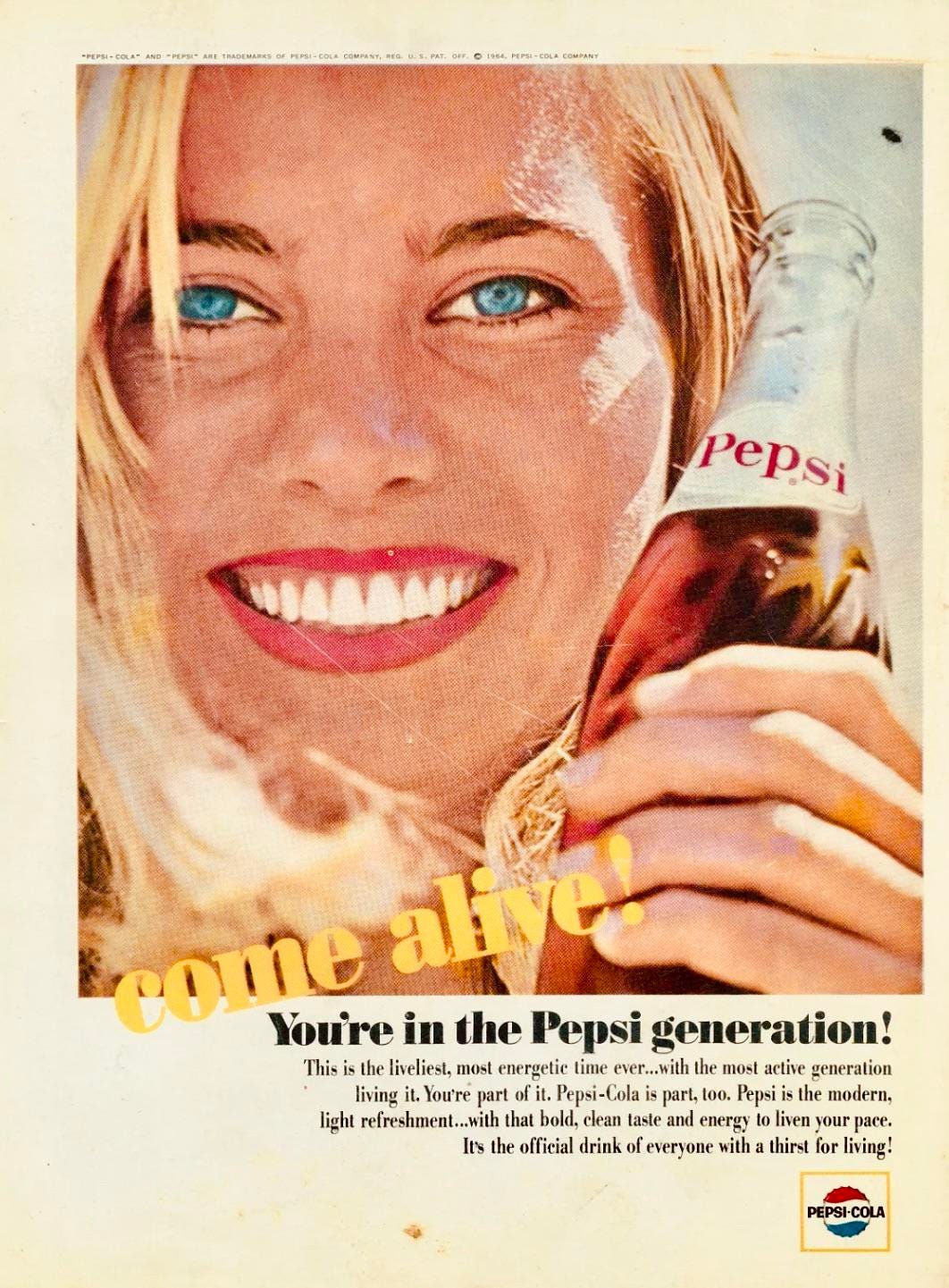
Then, in 1963, deadly rival Pepsi had just launched a new advertising campaign featuring a blue-eyed, beach-blonde girl urging baby boomers to ‘Come alive! You’re in the Pepsi Generation’. Pepsi was ‘light…bold…clean’ and above all ‘modern’. Coke, by implication, was ancient.
Project Arden
The Coca-Cola Company’s response was ‘Project Arden’, named in honour of marketing legend Elizabeth Arden, creator of the cosmetics empire. Its scale was unprecedented, encompassing everything ‘from identity and packaging, vehicle livery, uniforms and stationery, to the brand’s advertising and communications strategies’. Veteran brand strategy and design company Lippincott & Margulies, famous for its work on Campbell’s Soup and the interior of the U.S. Navy’s first nuclear submarine, was hired to do the work — a good fit for reviving a product that was both a consumer staple and national icon.
The result was a new logo, incorporating the famous ‘dynamic contour’ or swoosh as part of the logo, and the decision to launch a global marketing and ad campaign reviving the idea of Coke being ‘the real thing’.
Ira C. Herbert, Coke’s brand manager, explained the reasoning:
Young people today seek the real, the original and the natural as an escape from phoniness.
Coke’s iconic stature, he argued, could meet this need, challenging the upstart Pepsi’s insurgency.
But how to add fizz to a slogan that, let’s face it, had gone a little flat?
Mad Men and McCann Erickson
Step up the McCann Erickson advertising agency. In early 1971, its creative director Bob Backer started work on a new radio jingle for Coke’s relaunch.
Stranded by bad weather at an airport in Ireland en-route to a London recording studio, he noted how fellow passengers shared soft drinks while marooned in the airport’s cramped departure lounge.
He scribbled on a napkin ‘I’d Like to Buy the World a Coke’.
When he finally reached his destination, he presented this gnomic declaration to Rogers Greenaway and Cook, a British songwriting duo who had worked with Backer on a previous project. The result was performed by the New Seekers, a London-based group. They were newcomers to the pop scene, their distinctive folk and gospel influences combining a hint of youthful rebelliousness with homespun wholesomeness — just the kind of combination Backer thought his client was after.
The recordings were shipped back to New York and sent to radio stations across the US. With an adman’s eye for narrative tension, Backer later recalled in his memoirs how ‘it was met with deafening silence from the public and with worse from the Coca-Cola bottlers’—the companies who bought the syrup and bottled it for distribution. Basically: where was the hard sell? People just did not ‘get it’, the idea of someone buying something for ‘the world’.
But Backer, who describes himself as ‘born and bred stubborn’, persisted, and decided a ‘TV execution’—a television ad—would bring the abstractions to life. The lyrics were tweaked in the opposite direction to those demanded by the bottlers, with the opening line changed from ‘I’d like to buy the world a Coke’ to the even more baffling ‘I’d like to buy the world a home’.
A chorus of school children and students, multicoloured and multicultural, some dressed in traditional national costume, all with perfect teeth, were duly assembled on a bucolic hilltop near Rome, and told to mime the New Seekers song, a hymn to trees and bees, love and turtledoves, hands grasping Coke bottles (logo unobscured by fingers), reaching as its crescendo the declaration that ‘what the world wants today’, which was the ‘real thing’.
It is a measure of the success of ‘Hilltop’, as the ad came to be known, that there was little comment on its staggering audacity: having annexed Father Christmas in 1931 by turning him into the jovial, frothy-bearded, fur-trimmed-scarlet-pantsuited senior of a million grottos and office parties, Coca Cola was now laying claim to deciding what was real!
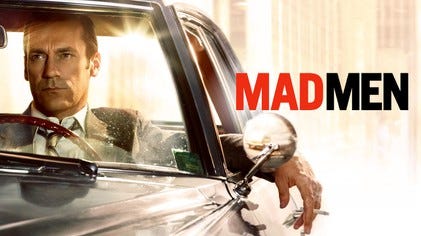
It took the pitch-dark satire of the TV drama Mad Men to expose the irony.
The series explored the corrupting influence of advertising’s golden age on its practitioners as well as its public. In its finale, set in 1970, we find its antihero Don Draper exiled to a hippie colony by a series of mishaps arising from his own moral decline. Alienated from everyone who had meant anything to him, apparently turning his back on a chance to work on McCann Erickson’s Coca-Cola campaign, he is shown taking part in a group meditation at an ocean-side retreat. The group’s guru promises a ‘new day, new ideas’, as a Tibetan bell chimes and a Buddhist chant begins.
The camera pans across the group, closing in on Don’s face. An expression of earnest concentration gives way to a self-satisfied smile, as the meditation seems to have the desired inspirational effect.
The sequence then cuts abruptly not to Don having found himself, working contentedly in a Californian ashram or winery, but to ‘Hilltop’, the ad acting as the series epilogue, suggesting that its shameless exploitation of youthful idealism for corporate profit was Don’s brainchild—the triumph of expediency over authenticity, surface over depth, seduction over love, consumerism over reality.
But wait…what if it really is the Real thing?
Don Draper powerfully dramatised the discourse that now prevails around these sorts of questions: marketing is a lie, and we are all its stooges.
So how come the Coca-Cola Company hasn’t abandoned its trademarked claim? Is it because it knows the secret of exploiting some mysterious subliminal impulse? Is it because it knows how to hypnotise the misery and alienation of its hapless customers, luring them into identifying with a (fake, presumably) story of American greatness? Is it because constant repetition has emptied it of meaning, like a prayer or a mantra? Is it because you need a course in critical thinking to decode its hegemonic commodification of contemporary ontologies?
Or dare one suggest that there might really be something real about it: the product’s storied history, the collective memory it evokes — an inexpensive, ubiquitous, unchanging object and taste (tactfully passing over a disastrous experiment to change them), the ritualised familiarity that is simply unreproduceable without the passage of time and coordination of circumstances?
In fact — to push the boat out into even deeper water — is there not in the presence of Coke a hint of what led to the emergence of the idea of reality in the first place: the grounding of something transcendental, something beyond us and our experience, in an everyday life?
Tune in next week for the final part of my series about Dan Brown and the ‘invention’ of reality…